
Multiscanning Technology
Scan Every USB Device With Multiple Antimalware Engines
TYREX Decontamination Stations combine up to five antivirus engines, two AI-powered antimalware engines, and hardware-level BadUSB detection in a single scan. Every file is scrutinized to identify and neutralize threats before removable devices connect to your network.

Decontamination Stations Deployed
Customers Worldwide
Signature-Based Antivirus
Anti-Malware Solutions
Single-Engine Scanning Leaves USB Security Gaps
Research shows that any individual engine detects fewer than 80% of new threats and may take several weeks to add a signature. Detection gaps expose organizations that rely on USB devices to malware and advanced persistent threats.
Inconsistent Detection
No two antivirus engines see the same threats at the same time. Each vendor collects samples from different sources and prioritizes different threat families.
Zero-Day Blind Spots
Signature-based antivirus engines can only detect threats that have been cataloged. When a new exploit appears, it passes through undetected.
Hardware-Level Attacks
A device that appears to be an ordinary USB drive can masquerade as a keyboard at the hardware level and inject malicious commands the moment it is connected.
Our Technology Partners
Trusted by 350+ organizations worldwide across energy, manufacturing, maritime, aerospace, and government.




Close The Detection Gap with TYREX Multiscanning for Removable Media
Multi-engine scanning improves detection coverage against recent threats. But all signature-based engines share a limitation. They match files against databases of known threats. No matter how many you run in parallel, some threat categories will not be detected.
TYREX combines signature-based multiscanning technology with AI-powered code analysis and hardware-level inspection to create a detection architecture where each layer covers the blind spots of the others.
How TYREX Multiscanning Works
TYREX is a comprehensive, USB security solution centered on user-friendly, plug-and-play USB Decontamination Stations. TYREX Stations are easy to install, manage, and use.
Users connect their device to begin the decontamination process. TYREX stations accept USB drives, external hard drives, and more.
Scan
Every file is analyzed by up to five antivirus engines and two AI-powered antimalware engines.
Clean
The station quarantines or removes malicious content while preserving legitimate files intact.
Certify
Stations can issue a secure digital certificate. Endpoints running the optional Workstation Protect Agent permit only certified devices to connect.
Secure Your Most Sensitive Infrastructure Today
TYREX removable media security is trusted by 350+ organizations worldwide across energy, manufacturing, maritime, aerospace, and government sectors. Our decontamination stations protect over 5,000 public and commercial infrastructure locations.
USB Threat Detection in Depth
TYREX's multiscanning architecture provides comprehensive protection against every major class of USB-borne threat.
The signature layer runs up to five antivirus engines from geographically diverse vendors, each maintaining independent signature databases and update cadences. Where one engine’s database has a gap, another’s is likely to have the signature.
- Known malware
- Commodity threats
- Recently cataloged variants
- Threats with published signatures
AI-Powered Code Analysis
GLIMPS uses deep learning and code conceptualization to analyze the structure of compiled binaries. It can identify malware variants and zero-day attacks even when the code has been modified or rewritten to evade signature-based detection.
- Zero-day exploits
- Novel malware variants
- Obfuscated scripts
- Evasive threats
AI Behavioral Analysis
Airbus Orion Malware combines multiple antivirus engines, machine learning, heuristic analysis, and dynamic sandboxing to evaluate files. It produces detailed threat reports with behavioral classification mapped to the MITRE ATT&CK framework and exportable indicators of compromise (IOCs).
- Advanced persistent threats
- Targeted attacks
- Threats requiring forensic classification
Hardware BadUSB Detection
Firmware-level attacks are invisible to standard antivirus and antimalware solutions. TYREX stations flag devices whose declared identity is inconsistent with their physical type. If a BadUSB device activates, its payload executes against a hardened kiosk with no path to your network.
- BadUSB firmware exploits
- Keystroke injection attacks
- Device identity spoofing
- USB protocol-level threats
Multiscanning Configured to Your Security Requirements
The default TYREX Decontamination Station configuration ships with two antivirus engines. Organizations can expand to the full seven-engine stack with AI analysis based on their threat profile and compliance requirements.
Detection Profiles
Organizations choose from a range of engine configurations depending on their risk posture. Standard deployments run multiple signature-based antivirus engines. High-security environments can add Glimps and Airbus Orion Malware AI engines for zero-day and advanced persistent threat detection.
Centralized Engine Management
The TYREX Management Server orchestrates engine and signature database updates. Administrators can push updates across their entire fleet from a single console while monitoring station health in real time. In air-gapped environments, updates are delivered via secure physical media transfers.
Take Your First Step Toward Complete USB Security
TYREX USB Decontamination Stations for Any Scenario
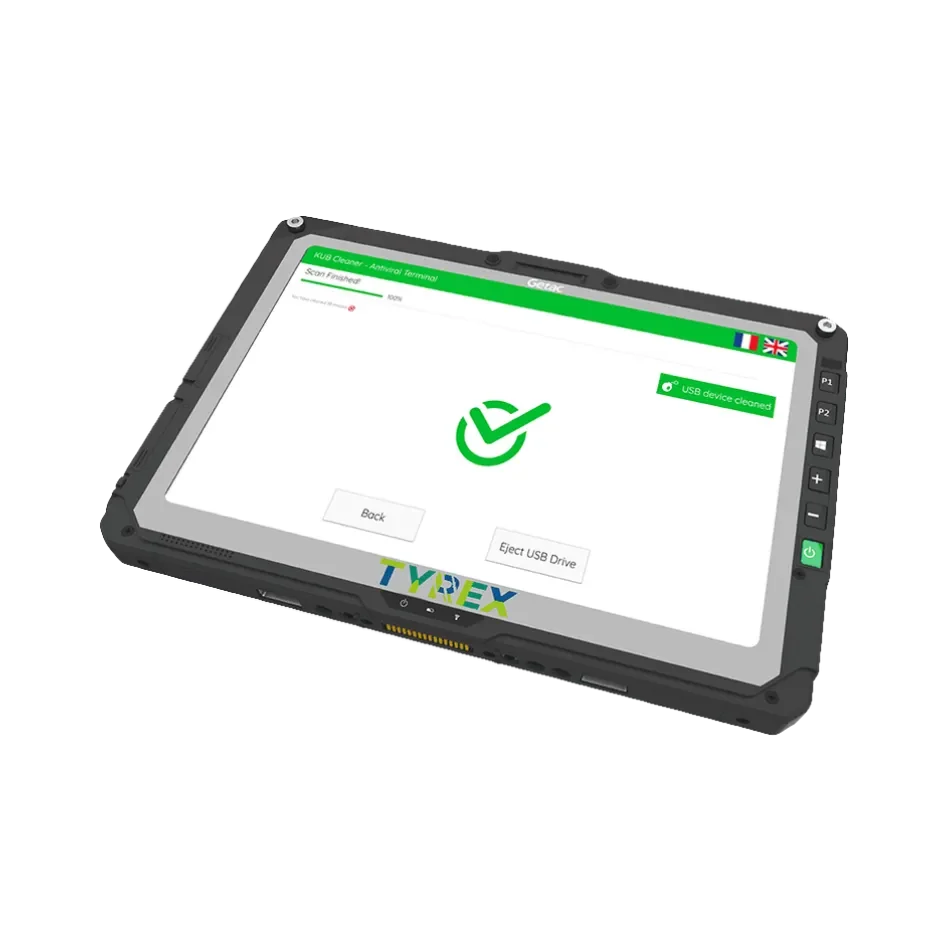
A rugged, portable unit ideal for mobile teams.
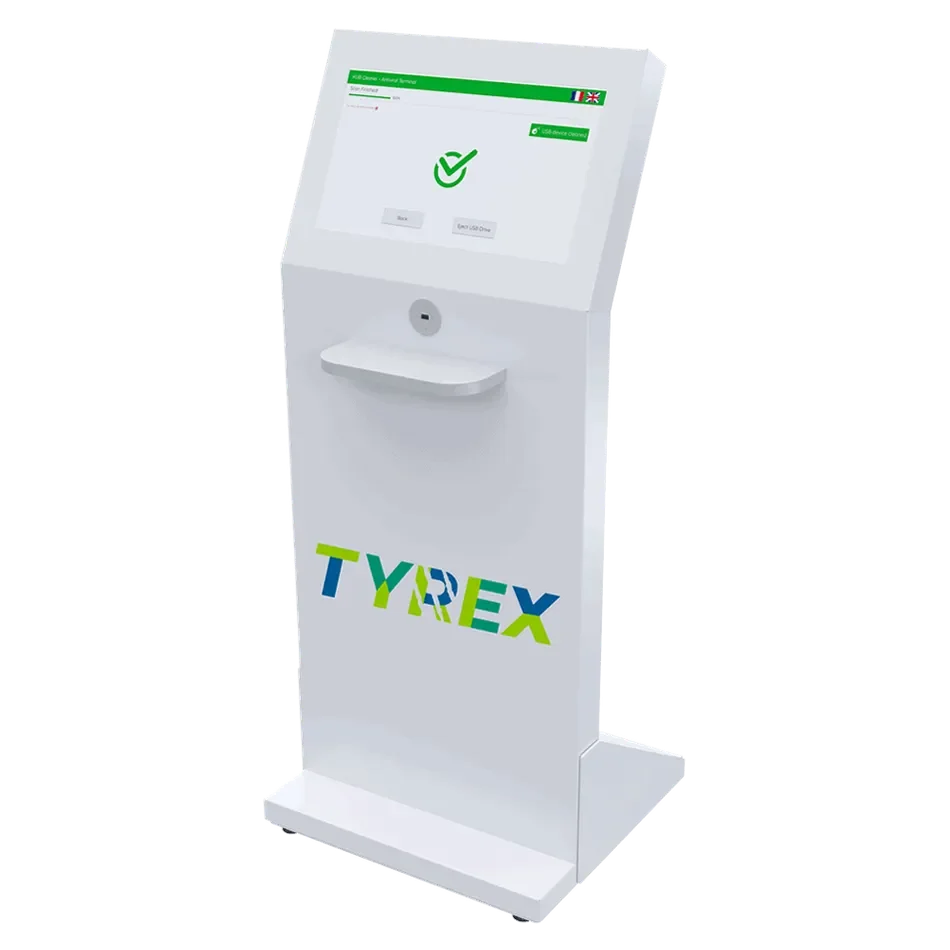
A freestanding kiosk with a 22-inch display for high-traffic areas and self-service decontamination.
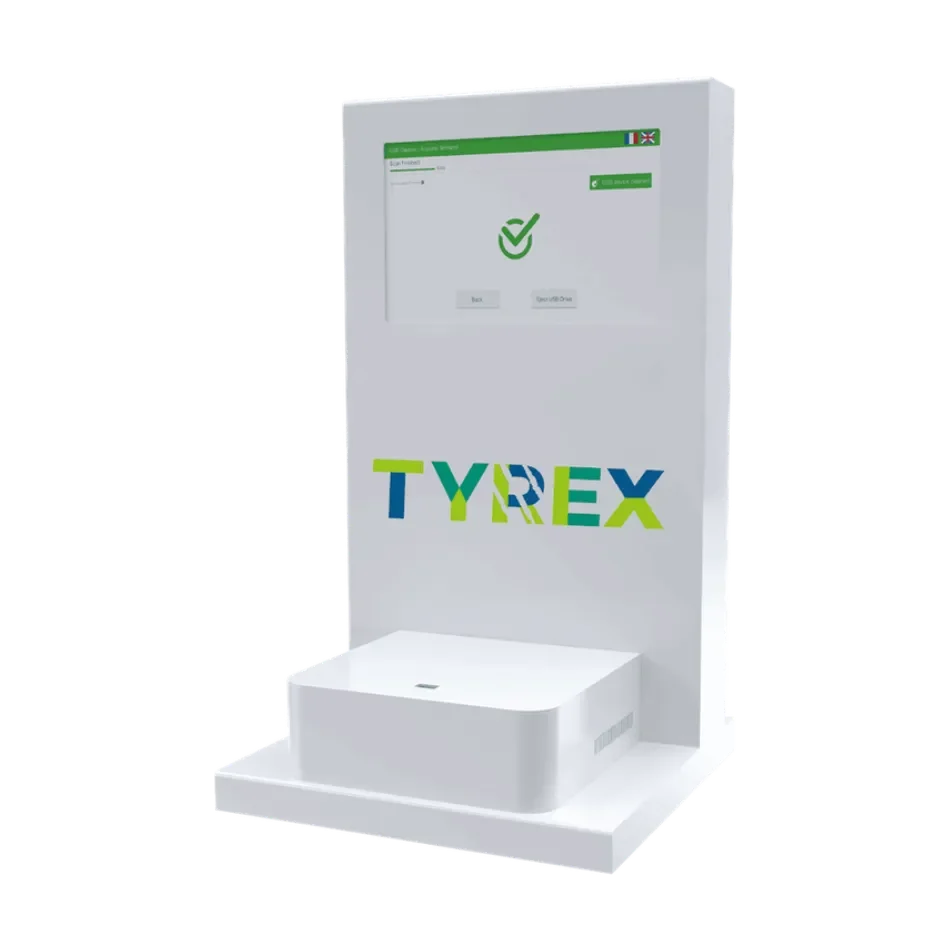
A desktop decontamination station for offices and standard workplaces.
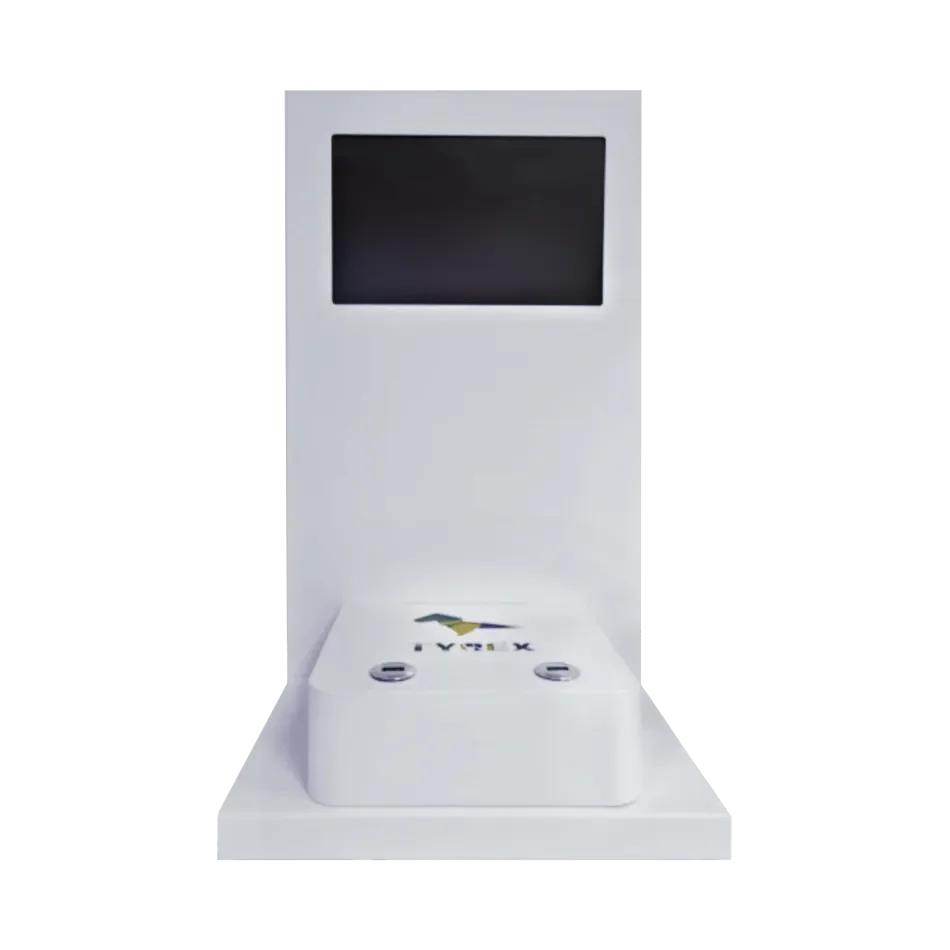
For secure outbound data transfers to external parties.
Frequently Asked Questions About USB Multiscanning Technology
Does running multiple engines increase false positives?
It can if you run too many of the same type. TYREX limits signature engines to five and adds malware engines that use different detection logic. When multiple engines using different methods agree on a verdict, confidence is higher and false positives are lower than with signature-only approaches.
Why not just add more and more antivirus engines?
There are diminishing returns. Three to five engines capture most of the detection benefit for known threats, and beyond that, you add complexity and false positives without meaningful gains. TYREX carefully selects the signature-based virus and malware detection engines available on our stations to maximize detection rates while minimizing false positives.
How long does a full multiscan take?
Scans take seconds to minutes, depending on data volume and which engines are enabled.
Can we choose which engines are active on our stations?
Yes. You can select your preferred signature-based antivirus engines and AI engines, and you can change the profile as requirements evolve. All configurations include BadUSB hardware detection as standard.
How are detection engines and AI models kept up to date?
The TYREX Management Server pushes all updates centrally. For air-gapped environments, updates are delivered via secure physical media. Organizations manage one update relationship with TYREX rather than separate agreements with each engine vendor.
Add USB Multiscanning to Your Cybersecurity Program