
USB Malware Findings From the TYREX USB Threat Radar
The TYREX USB Threat Radar is a free, one-page briefing published every two months and built on data collected directly from TYREX decontamination stations. No surveys or extrapolation. See what our stations intercepted in July–August 2026 and how to interpret the findings.
*Free • 1 page • 3-minute read
1.86%
Of scanned devices were infected (down 1.05% vs May–June)
2.46
Threats per infected device
35%
Of detections built to spread through the drive itself
37%
Of detections were Trojans, the dominant category

Get Your Free Copy
Enter your details and we’ll send the Radar straight to your inbox.
USB Security Risks From Infected Devices
The USB threats that fill our detection logs are not exotic. They are fake shortcuts, self-spreading worms, and Trojans that look harmless until someone double-clicks. They slip past firewalls and network monitoring because they never cross the network: they walk in through the USB port.
Built to Spread Through the Drive
35% of the detections in this period were designed to propagate through the removable device itself, using autorun or malicious shortcut (LNK) files. The drive isn’t just a carrier. It is the attack vector.
One Infected Drive Rarely Carries One Threat
Each infected device carried an average of 2.46 threats. When a drive is compromised, assume it brings company.
Invisible to Users and Conventional Antivirus
The period’s most-detected threat hides inside the file tree and runs when a user double-clicks it. Nothing looks suspicious, and nothing alerts the user.
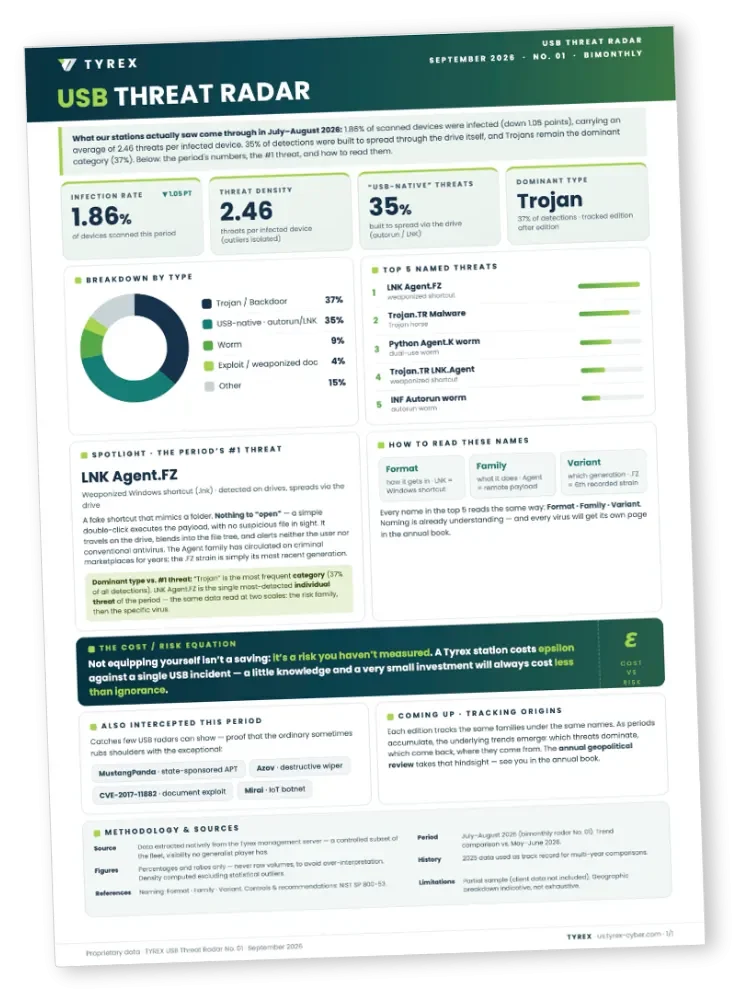
What’s Inside the USB Threat Radar
- The period’s key numbers: infection rate, threat density, and trend versus the previous period
- Breakdown by threat type: Trojans and backdoors, USB-native threats, worms, exploits, and weaponized documents
- The top five named threats detected by TYREX stations
- A spotlight on the #1 threat: what it is, how it travels, and why it goes unnoticed
- A simple guide to reading any malware name: Format · Family · Variant
- Other threats intercepted by TYREX stations
- The costs and risks of leaving USB ports unprotected
This Period’s #1 Threat: A Folder That Isn’t One
LNK Agent.FZ is a weaponized Windows shortcut disguised as a folder. Double-clicking what looks like a folder runs the payload, with no suspicious file in sight. It travels on the drive and blends into the file tree, escaping notice by the user and detection by conventional antivirus.
The Agent family has circulated on criminal marketplaces for years. The .FZ strain is its most recent variant.
HOW TO READ A MALWARE NAME
LNK Agent.FZ
Format – How it gets in
LNK = Windows shortcut
Family – What it does
Agent = Remote payload
Variant – Which generation
.FZ = 6th recorded strain
Also Intercepted by TYREX Stations This Period
Other detections included:
MustangPanda
State-sponsored advanced persistent threat (APT)
Azov
Destructive wiper
CVE-2017-11882
Document exploitCVE-2017-11882: document exploit
Mirai
Internet of Things (IoT) botnet

Where the Data Comes From
The Radar is built on data extracted directly from the TYREX Management Server, which records scanning activity across the TYREX station fleet.
- Source: a controlled subset of the TYREX station fleet
- Period: July–August 2026, compared with May–June 2026; 2025 data provides historical context
- Figures: percentages and ratios rather than raw counts to reduce the risk of misinterpretation; threat density excludes statistical outliers
- References: malware names read as Format · Family · Variant; controls and recommendations mapped to NIST SP 800-53
- Limits: partial sample (customer data not included)
How TYREX Stops These Threats Before They Reach Your Systems
Every threat in this Radar was intercepted at a TYREX decontamination station before the device connected to a production system.

Insert
The user connects a USB drive or other removable media to a TYREX station.

Analyze
The station scans every file with up to five antivirus engines and two AI-powered antimalware engines, GLIMPS and Airbus Orion Malware, plus hardware-level BadUSB detection. Learn about multiscanning.

Clean
Infected files are quarantined or removed, and the user sees a clear report of what was found.

Certify
The device receives a digital certificate. With the Workstation Protect Agent, endpoints block access to any device or file that hasn’t been certified.
Trusted by 350+ organizations worldwide across energy, manufacturing, maritime, aerospace, and government.
USB Threat Data for IT and OT Security Teams
The Radar is written for CISOs, OT and ICS security teams, IT managers, and compliance leads whose organizations use USB drives to transfer data into critical systems.
Common Questions About the USB Threat Radar
What is the TYREX USB Threat Radar?
The TYREX USB Threat Radar is a free, one-page report published every two months on the USB threats intercepted by TYREX decontamination stations. Its findings use data extracted directly from the TYREX Management Server and are presented only as percentages and ratios.
What share of USB devices were infected in July–August 2026?
According to the TYREX USB Threat Radar, 1.86% of scanned devices were infected in July–August 2026, down 1.05 percentage points from May–June 2026. Each infected device carried an average of 2.46 threats.
What was the most common USB threat in July–August 2026?
Trojans were the dominant category, at 37% of detections in July–August 2026. The single most-detected threat was LNK Agent.FZ, a weaponized Windows shortcut disguised as a folder.
What is a USB-native threat?
A USB-native threat is malware built to spread through the removable device itself, typically through autorun or malicious shortcut (LNK) files. USB-native threats accounted for 35% of detections in the July–August 2026 TYREX USB Threat Radar.
How do you read a malware name like LNK Agent.FZ?
Malware names read as Format · Family · Variant. In LNK Agent.FZ, LNK is the format (a Windows shortcut), Agent is the family (a remote payload), and .FZ is the variant (its sixth recorded strain).
How often is the Radar published?
Every two months. Each edition tracks the same threat families under the same names, so trends become visible over time. An annual report covers the full year in depth.
Download the TYREX USB Threat Radar
Download the first TYREX USB Threat Radar and see what actually came through the USB port in July–August 2026. Want to know what a TYREX station would catch at your sites? Our experts will walk you through it.